


-

Let’s Get Out of the Starting Block on Generative AI!
Mark Lehrer
Generative AI (GenAI) will impact many different aspects of university life in a highly heterogeneous manner. Some impacts are immediate and require an urgent response. Others will take considerable time to materialize and unfold according to how the university decides to use GenAI. GenAI is evolving so rapidly that the magnitude and nature of many effects cannot be easily predicted. This report, based on inputs from fellows of the Center for Innovation and Change Leadership (CICL), offers a framework to assist administrators in organizing the university’s response to this massive challenge.
-
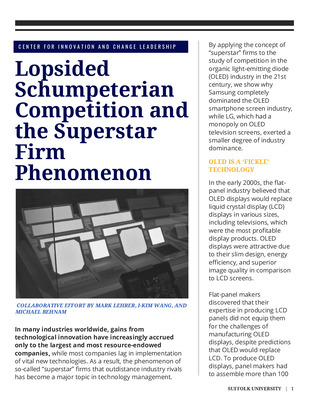
Lopsided Schumpeterian Competition and the Superstar Firm Phenomenon
Mark Lehrer, I. Kim Wang, and Michael Behnam
In many industries worldwide, gains from technological innovation have increasingly accrued only to the largest and most resource-endowed companies, while most companies lag in implementation of vital new technologies. As a result, the phenomenon of so-called “superstar” firms that outdistance industry rivals has become a major topic in technology management.
-
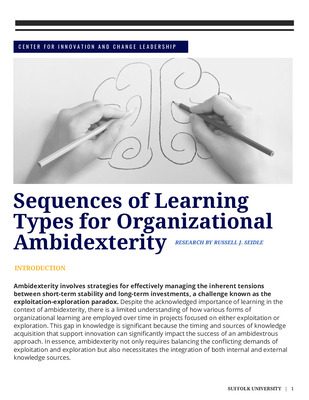
Sequences of Learning Types for Organizational Ambidexterity
Russell J. Seidle
Ambidexterity involves strategies for effectively managing the inherent tensions between short-term stability and long-term investments, a challenge known as the exploitation-exploration paradox. Despite the acknowledged importance of learning in the context of ambidexterity, there is a limited understanding of how various forms of organizational learning are employed over time in projects focused on either exploitation or exploration. This gap in knowledge is significant because the timing and sources of knowledge acquisition that support innovation can significantly impact the success of an ambidextrous approach. In essence, ambidexterity not only requires balancing the conflicting demands of exploitation and exploration but also necessitates the integration of both internal and external knowledge sources.
-
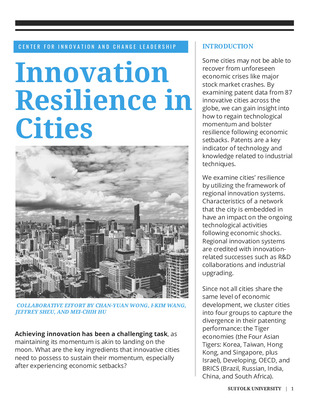
Innovation Resilience in Cities
Chan-Yuan Wong, I. Kim Wang, Jeffrey Sheu, and Mei-Chih Hu
Achieving innovation has been a challenging task, as maintaining its momentum is akin to landing on the moon. What are the key ingredients that innovative cities need to possess to sustain their momentum, especially after experiencing economic setbacks?